Commercial Construction Estimating in South Carolina
Commercial construction estimating in South Carolina requires navigating a rare dual-threat structural environment: major coastal hurricane wind design and severe historic seismicity around Charleston, alongside booming automotive and aerospace manufacturing in the Upstate.
Governed statewide by the 2021 South Carolina Building Code under the Building Codes Council (SCBCC), commercial projects in Coastal South Carolina (Charleston, Beaufort, Horry, Georgetown) face basic design wind speeds from 130 to 150 mph alongside Seismic Design Category D criteria from the historic 1886 Charleston fault. Estimators must detail ductile structural connections, nonstructural MEP seismic restraints, impact-rated storefronts, and elevated coastal pile foundations.
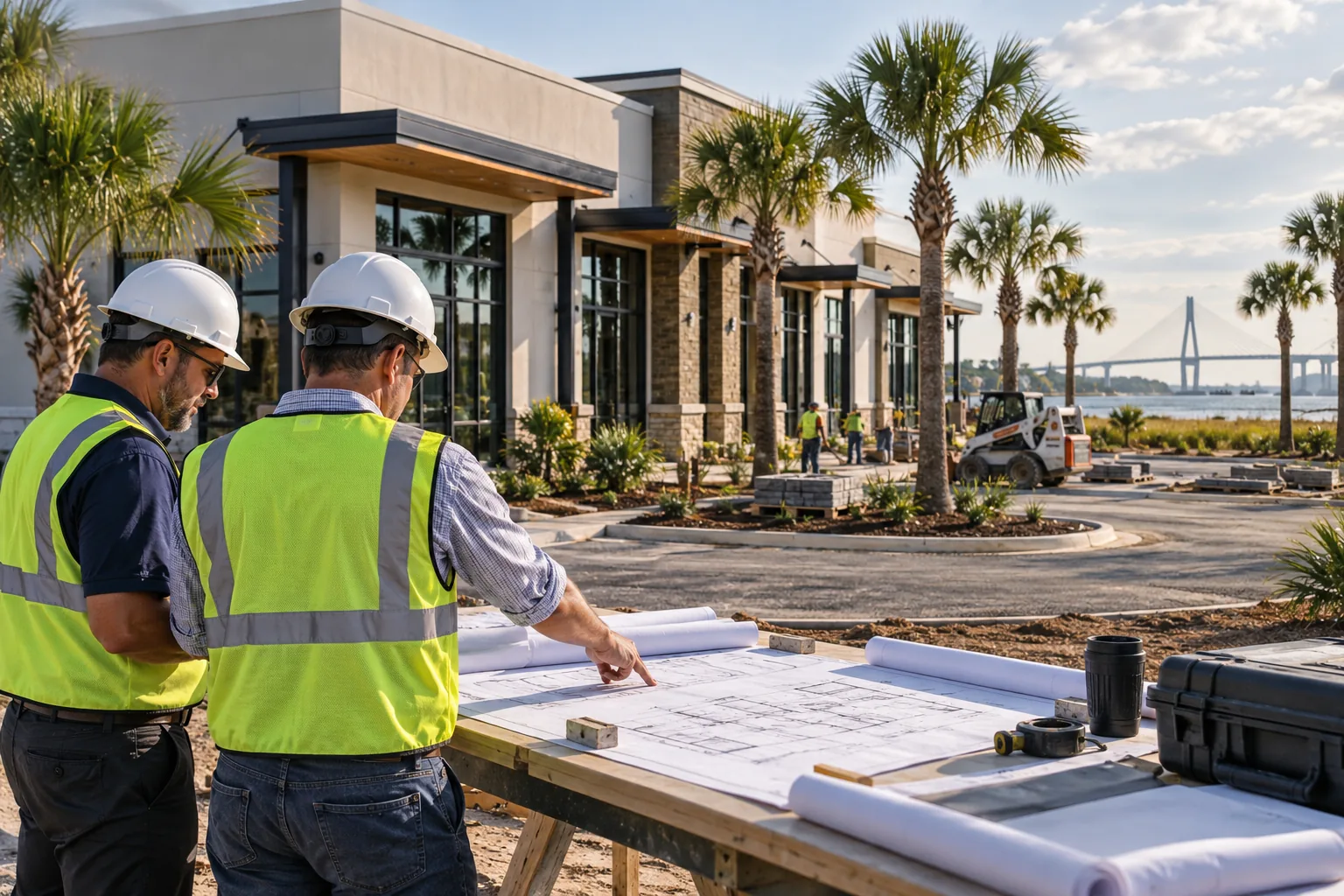
Commercial Estimating Landscape in South Carolina
From advanced automotive assembly and tire plants in Greenville and Spartanburg to maritime port logistics in Charleston, our takeoffs deliver accurate material quantification.
South Carolina Building Codes Council (SCBCC) — Department of Labor, Licensing and Regulation (LLR)
Governing Framework: Statewide Mandatory with State Modifications
Governs commercial plan review baseline requirements, occupancy classifications, and state-level regulatory jurisdiction.
2021 South Carolina Building Code (based on 2021 IBC with SC modifications; effective January 1, 2023)
Baseline standard for structural load paths, fire-resistance assemblies, egress geometry, and life-safety systems.
2009/2021 International Energy Conservation Code with South Carolina modifications
Governs building envelope continuous insulation, fenestration U-factors/SHGC, lighting power density (LPD), and HVAC efficiency ratings.
Building Code Adoption & Permitting Framework
Accurate commercial estimating requires understanding how statewide building standards interact with local municipal Authority Having Jurisdiction (AHJ) amendments.
Jurisdiction & Regulatory Structure
Statewide mandatory code enforced through municipal and county building departments. Coastal Charleston and Grand Strand enforce hurricane wind-borne debris rules (130-150 mph design wind speeds) and coastal flood hazard rules. Charleston sits in a major historic seismic hazard zone (SDC D); Upstate features heavy automotive industrial manufacturing.
Commercial Energy Code & Envelope Baseline
Commercial projects must comply with 2009/2021 International Energy Conservation Code with South Carolina modifications. Estimators must carefully verify continuous insulation (ci), fenestration thermal performance, and mechanical economizer thresholds before finalizing quantity takeoffs.
Verified Primary Regulatory Sources
The following official state regulatory resources govern construction standards and energy compliance for projects in South Carolina:
- South Carolina Building Codes Council — Adopted Codes ↗ — South Carolina LLR
- South Carolina Department of Commerce — Energy Office ↗ — South Carolina Energy Office
- US DOE — South Carolina Commercial Energy Code Status ↗ — US Department of Energy
Official sources independently verified for jurisdictional reference. Statutory adoption varies by municipality, occupancy classification, and local permit date.
State-Specific Takeoff & Bid Preparation Workflow
Our remote commercial estimating methodology ensures every plan set in South Carolina undergoes systematic drawing reconciliation and audit-ready takeoff generation.
Determine project location. In coastal counties, inspect structural general notes for ultimate design wind speed (130-150 mph) AND seismic design category (SDC D in Charleston). In Upstate, check civil drawings for Piedmont red clay and granite rock.
Isolate coastal wind and seismic assemblies: impact-rated storefronts, continuous tie-down straps, and MEP nonstructural seismic strut/cable restraints. In Upstate industrial hubs, quantify heavy slab-on-grade thicknesses (7" to 9" reinforced with fibers or rebar mats).
Coordinate commercial HVAC equipment against hot-humid Climate Zone 3A conditions. Sizing must handle high summer outdoor humidity.
Check Division 07 for wind uplift fastening schedules per ASCE 7-22 and Division 08 for coastal impact certifications.
Document assumptions regarding coastal flood elevation surveys, Charleston seismic special inspection allowances, and local municipal permit fees.
Takeoff Scope Model: Commercial Healthcare & Office (50,000 Gross SF, 3 Stories, Structural Steel Frame with Ductile Braced Frames (SCBF))
Illustrative takeoff modeling coastal hurricane wind framing, Charleston seismic detailing, and impact storefront in Charleston County.
| Scope Assembly | Measured Quantity / Basis | Takeoff Unit Basis |
|---|---|---|
| Structural Steel Framing & Seismic SCBF (SDC D) | 390 | Tons (AISC 341 ductile connections, heavy gussets) |
| Seismic Restraints for Suspended MEP Distribution | 460 | Locations (ASCE 7-22 SDC D cable/strut braces) |
| Hurricane Impact-Resistant Storefront (140 mph rated) | 9,200 | SF (ASTM E1886/E1996 large missile rated) |
| High-Uplift Mechanically Fastened TPO Roof Assembly | 18,000 | SF (R-25 continuous polyiso, enhanced perimeter) |
| Driven Prestressed Concrete Foundation Piles (14" sq) | 140 | Piles (50 ft depth in coastal alluvial soils) |
Key Takeoff Considerations for this Scope:
- Structural steel takeoff itemizes heavy seismic connection plates and ductile detailing per AISC 341.
- Glazing scope itemizes certified large-missile impact storefront systems compliant with coastal codes.
- Suspended MEP distribution takeoff includes engineered seismic wire/rigid strut bracing assemblies.
Critical Trade Coordination Points for South Carolina
Commercial estimating requires rigorous alignment between interconnected CSI divisions. Here are key trade coordination checkpoints relevant to South Carolina projects:
Structural Steel →
Structural steel estimating in Charleston requires pricing ductile seismic framing and high-wind connections.
Key Takeoff Checkpoints:- Quantify Special Concentrically Braced Frames (SCBF) or Moment Frames per AISC 341.
- Measure structural seismic bracing members and anchor bolts in Seismic Design Category D.
- Itemize nonstructural seismic cable/strut restraints across suspended plumbing, mechanical, and electrical runs.
Glazing →
Commercial glazing estimates must differentiate coastal hurricane impact systems from standard commercial storefronts.
Key Takeoff Checkpoints:- Verify impact-rated laminated glass tested to ASTM E1886/E1996 for coastal counties.
- Measure heavy-wall aluminum storefront framing with structural silicone glazing.
- Verify solar heat gain coefficient (SHGC <= 0.25) compliance with energy baseline.
Concrete →
Concrete estimating requires budgeting for deep pile foundations on the coast and heavy industrial floors in Upstate.
Key Takeoff Checkpoints:- Quantify driven timber or precast prestressed concrete piles in coastal flood zones.
- Measure heavy industrial slab-on-grade with continuous 15-mil vapor barriers and armored joints in Upstate.
- Itemize continuous perimeter grade beams and turn-down thickened slab edges.
Project Documents Needed for an Accurate South Carolina Estimate
To deliver an audit-ready quantity takeoff for your project in South Carolina, we require the following drawing packages and project records:
Submission Requirement
Architectural Plan Set (demising walls, floor plans, building elevations, wall sections)
Submission Requirement
Structural Engineering Documents (framing layouts, wind design criteria, seismic parameters, foundation schedules)
Submission Requirement
Mechanical, Electrical, and Plumbing Plans & Schedules
Submission Requirement
Geotechnical Engineering Report (soil borings, seismic site class, liquefaction potential, bearing capacity)
Submission Requirement
South Carolina Commercial Energy Code Compliance Package (COMcheck reports)
Submission Requirement
Project Specification Book (Divisions 01 through 33)
Frequently Asked Questions: South Carolina Construction Estimating
Direct answers to common questions about commercial quantity takeoffs, local jurisdiction adjustments, and remote estimating deliverables in South Carolina.
What building codes govern commercial construction in South Carolina?
Commercial construction in South Carolina is governed statewide by the 2021 South Carolina Building Code, administered by the Building Codes Council (SCBCC) under LLR. It is based on the 2021 International Building Code with state modifications.
Why is structural estimating unique in Charleston, South Carolina?
Charleston is one of the few metropolitan areas on the East Coast subject to BOTH high hurricane wind loads (130-150 mph) and high seismic hazard (Seismic Design Category D from the historic 1886 Charleston earthquake). Estimators must price ductile structural steel frames, heavy gussets, and comprehensive nonstructural MEP seismic restraints.
What wind design speeds apply to coastal South Carolina commercial projects?
Coastal South Carolina (Charleston, Myrtle Beach, Beaufort, Hilton Head) specifies basic design wind speeds ranging from 130 to 150 mph. Commercial projects require certified impact-resistant fenestration, enhanced roof uplift fastening, and continuous tie-down load paths.
Does CommercialEstimatePro provide on-site estimating in South Carolina?
No. CommercialEstimatePro is a nationwide remote construction estimating service. All takeoffs are produced digitally from contractor-provided design documents.
Get an Audit-Ready Commercial Estimate for Your South Carolina Project
We provide remote quantity takeoffs and commercial construction cost estimates to general contractors, subcontractors, architects, and owners across South Carolina and all 50 states. Every takeoff is itemized by CSI MasterFormat division with complete visual audit markups and customizable Excel workbooks.
CommercialEstimatePro operates as a centralized remote commercial estimating consultancy. We do not maintain local field offices or resident staff in South Carolina, nor do we provide licensed architectural, structural engineering, or on-site building inspection services. All material quantities and equipment counts are measured directly from your furnished design documents.
Explore Core Services, Trades & Sectors
Navigate our complete suite of commercial takeoff services, CSI division guides, and project types: