Commercial Construction Estimating in Georgia
Commercial construction estimating in Georgia requires understanding the regional economic divergence between the rapid industrial and commercial logistics expansion of Metro Atlanta and the coastal hurricane and maritime dynamics of Savannah.
Under the Georgia Department of Community Affairs (DCA), mandatory statewide codes govern commercial construction. While inland Georgia projects deal with hot-humid cooling loads, Piedmont red clay, and rock excavation, coastal commercial projects face Wind-Borne Debris Region design wind speeds (up to 140 mph) and high water table foundation engineering.
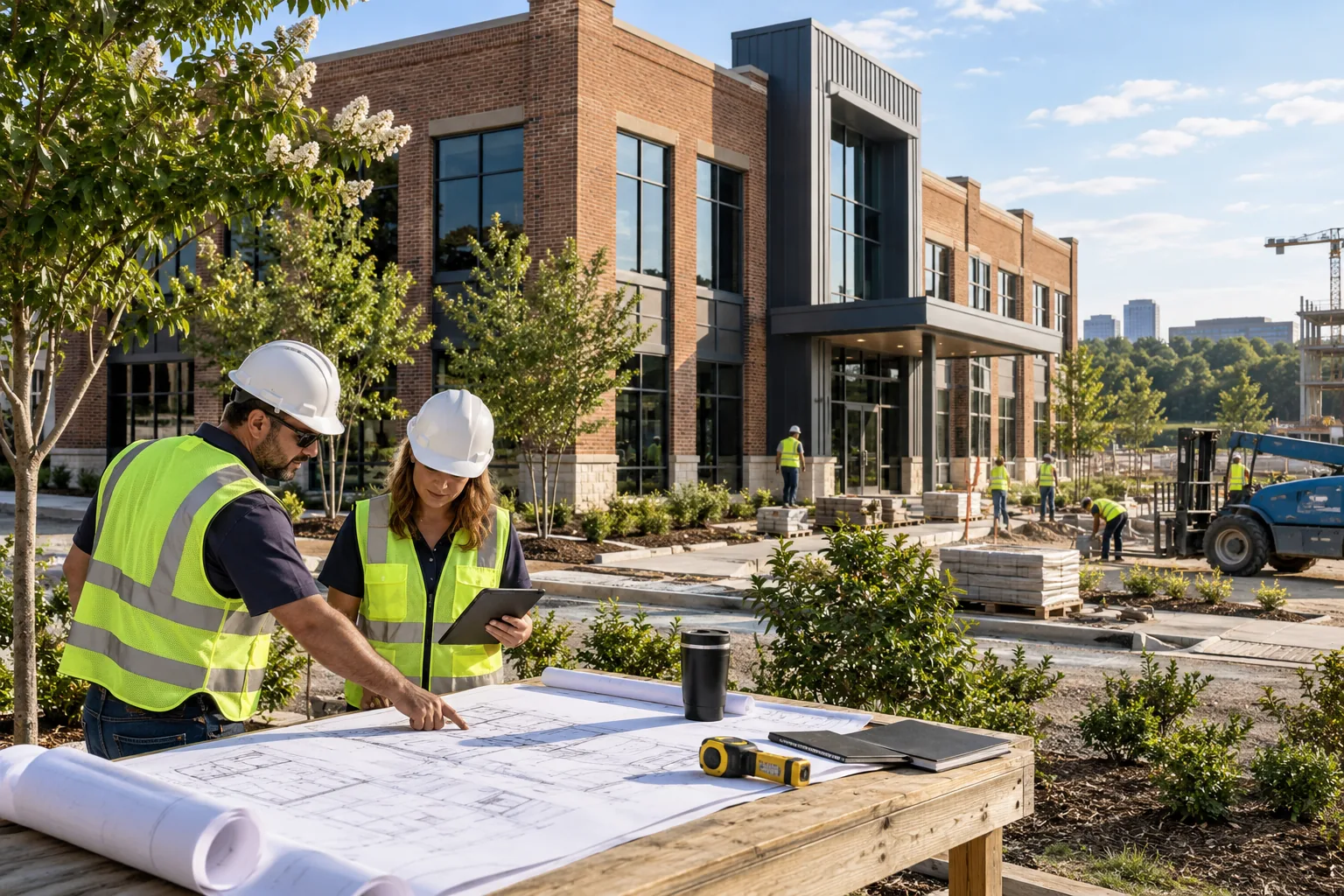
Commercial Estimating Landscape in Georgia
From advanced film production soundstages in Fayette County to multi-million square foot mega-distribution warehouses in Henry and Chatham counties, accurate quantity takeoffs demand detailed coordination of heavy industrial slab-on-grade thicknesses, stormwater detention underground vaults, and energy code compliance.
Georgia Department of Community Affairs (DCA)
Governing Framework: Statewide Mandatory with State Amendments
Governs commercial plan review baseline requirements, occupancy classifications, and state-level regulatory jurisdiction.
2018 International Building Code with Georgia State Amendments (mandatory statewide); local cities enforce through municipal building departments
Baseline standard for structural load paths, fire-resistance assemblies, egress geometry, and life-safety systems.
2015 International Energy Conservation Code with Georgia State Supplements and Amendments
Governs building envelope continuous insulation, fenestration U-factors/SHGC, lighting power density (LPD), and HVAC efficiency ratings.
Building Code Adoption & Permitting Framework
Accurate commercial estimating requires understanding how statewide building standards interact with local municipal Authority Having Jurisdiction (AHJ) amendments.
Jurisdiction & Regulatory Structure
Georgia mandates statewide minimum codes that apply to all local jurisdictions without requiring local municipal adoption. Local governments can adopt administrative enforcement rules and state-approved local amendments. In coastal counties (Chatham, Bryan, Liberty, McIntosh, Glynn, Camden), coastal wind-borne debris regulations apply.
Commercial Energy Code & Envelope Baseline
Commercial projects must comply with 2015 International Energy Conservation Code with Georgia State Supplements and Amendments. Estimators must carefully verify continuous insulation (ci), fenestration thermal performance, and mechanical economizer thresholds before finalizing quantity takeoffs.
Verified Primary Regulatory Sources
The following official state regulatory resources govern construction standards and energy compliance for projects in Georgia:
- Georgia Department of Community Affairs — Construction Codes ↗ — Georgia Department of Community Affairs
- Georgia Environmental Protection Division — Erosion and Sediment Control ↗ — Georgia Department of Natural Resources
- US DOE — Georgia Commercial Energy Code Status ↗ — US Department of Energy
Official sources independently verified for jurisdictional reference. Statutory adoption varies by municipality, occupancy classification, and local permit date.
State-Specific Takeoff & Bid Preparation Workflow
Our remote commercial estimating methodology ensures every plan set in Georgia undergoes systematic drawing reconciliation and audit-ready takeoff generation.
Examine structural design criteria sheet for basic design wind speed (elevated in coastal counties) and seismic design category (moderate in North Georgia, low in South Georgia). Check civil drawings for rock excavation indicators.
Isolate civil sitework scopes, particularly soil stabilization (lime or cement stabilization for wet Georgia Piedmont clays) and underground stormwater retention systems mandated by local watershed ordinances.
Coordinate commercial HVAC sensible and latent cooling capacities. Ensure commercial roof insulation complies with Georgia Energy Code minimum R-25 continuous or R-30 above deck.
Review concrete specifications for heavy warehouse slabs (6" to 8" thickness, joint filler, macro-synthetic or steel fiber reinforcement, vapor barrier ASTM E1745 Class A).
Clearly document assumptions regarding subsurface rock excavation, mass grading balanced site assumptions, and GDOT right-of-way tie-in responsibilities.
Takeoff Scope Model: Industrial Warehouse & Logistics (85,000 Gross SF, Single-Story, Tilt-Up Concrete Wall Panels with Steel Truss Roof)
This illustrative takeoff models civil earthwork, heavy industrial slab-on-grade, and single-ply roofing in the Metro Atlanta industrial corridor.
| Scope Assembly | Measured Quantity / Basis | Takeoff Unit Basis |
|---|---|---|
| Mass Grading Cut-to-Fill & Soil Stabilization | 42,000 | CY (Cut/fill balance with 5% cement treatment) |
| 7" Heavy Industrial Concrete Slab-on-Grade | 85,000 | SF (4,000 PSI, steel fiber reinforced, 15-mil vapor) |
| Tilt-Up Concrete Wall Panels (9.25" thick) | 44,800 | SF (Forming, casting slab, rebar, lifting inserts) |
| 45-mil Mechanically Fastened TPO Roof Assembly | 85,000 | SF (R-25 continuous polyiso above deck) |
| Underground Stormwater Detention Pipe Vault | 1,200 | LF (60" perforated corrugated aluminized pipe) |
Key Takeoff Considerations for this Scope:
- Earthwork includes cement soil stabilization layer due to moisture-sensitive Georgia Piedmont red clay.
- Slab-on-grade takeoff isolates heavy forklift loading zones with armored steel construction joints.
- Roofing takeoff complies with Georgia Energy Code R-25 continuous insulation requirements.
Critical Trade Coordination Points for Georgia
Commercial estimating requires rigorous alignment between interconnected CSI divisions. Here are key trade coordination checkpoints relevant to Georgia projects:
Sitework & Earthwork →
Commercial sitework in Georgia requires accounting for expansive clay characteristics, rock blasting in North GA, and strict erosion control.
Key Takeoff Checkpoints:- Quantify lime or portland cement soil modification to stabilize high-moisture native red clay subgrades.
- Identify potential rock excavation (trench rock vs mass rock) in projects north of the Fall Line (Atlanta / I-85 corridor).
- Measure extensive erosion control measures complying with Georgia EPD Manual for Erosion and Sediment Control (Green Book).
Concrete →
Concrete estimating in Georgia logistics hubs requires quantifying tilt-up panels, casting slabs, and heavy floor systems.
Key Takeoff Checkpoints:- Calculate casting beds, temporary panel bracing anchors, and perimeter joint sealants for tilt-up wall panels.
- Itemize heavy-duty slab-on-grade with continuous vapor barriers (15-mil polyolefin) and armored joints at dock aprons.
- Measure foundation footings, continuous grade beams, and dock pit wall formwork.
HVAC & Mechanical →
Mechanical takeoffs in Climate Zone 3A must balance high latent heat removal with ventilation requirements.
Key Takeoff Checkpoints:- Quantify dedicated outdoor air units (DOAS) with sensible heat exchangers to handle high summer outdoor humidity.
- Measure high-volume low-speed (HVLS) warehouse fans and louvers for distribution facilities.
- Itemize rooftop packaged units with multi-stage compressors and economizer dampers.
Project Documents Needed for an Accurate Georgia Estimate
To deliver an audit-ready quantity takeoff for your project in Georgia, we require the following drawing packages and project records:
Submission Requirement
Civil Engineering Drawings (existing contours, proposed grading, erosion control plans, utility connections)
Submission Requirement
Architectural Plan Set (dimensioned floor plans, building elevations, wall sections, door/hardware schedules)
Submission Requirement
Structural Engineering Set (foundation details, tilt-up panel elevations, roof framing schedules)
Submission Requirement
Geotechnical Subsurface Investigation Report (standard penetration tests, groundwater levels, rock core data)
Submission Requirement
Georgia Energy Code Compliance Forms (COMcheck certificates)
Submission Requirement
Project Manual and Division 00-33 Specifications
Frequently Asked Questions: Georgia Construction Estimating
Direct answers to common questions about commercial quantity takeoffs, local jurisdiction adjustments, and remote estimating deliverables in Georgia.
What building codes govern commercial construction in Georgia?
Georgia enforces the Georgia State Minimum Standard Codes administered by the Department of Community Affairs (DCA). The commercial framework is based on the 2018 International Building Code and 2015 International Energy Conservation Code with Georgia State Amendments. These codes are mandatory statewide and enforced by municipal and county building departments.
How does Georgia Piedmont soil affect commercial foundation and sitework estimating?
Much of Central and Northern Georgia (including Metro Atlanta) sits on the Piedmont geological province, characterized by weathered red clay subgrades and subsurface granite rock. Estimating sitework requires quantifying soil stabilization (lime or cement treatment) to handle moisture sensitivity, and including specific takeoff allowances for trench or mass rock excavation when utility depths exceed 6 to 8 feet.
What special wind requirements apply to coastal Georgia commercial projects?
Georgia’s six coastal counties (Chatham, Bryan, Liberty, McIntosh, Glynn, and Camden) are designated in wind-borne debris zones with ultimate design wind speeds reaching 130 to 140 mph. Estimators must price impact-rated exterior glazing, enhanced roof uplift fastening, and corrosion-resistant fasteners in coastal marine environments.
Does CommercialEstimatePro maintain local offices in Georgia?
No. CommercialEstimatePro is a nationwide remote construction estimating service. We do not operate local offices or employ physical personnel in Georgia. All estimates and quantity takeoffs are performed digitally based on drawings submitted by contractors.
Get an Audit-Ready Commercial Estimate for Your Georgia Project
We provide remote quantity takeoffs and commercial construction cost estimates to general contractors, subcontractors, architects, and owners across Georgia and all 50 states. Every takeoff is itemized by CSI MasterFormat division with complete visual audit markups and customizable Excel workbooks.
CommercialEstimatePro operates as a centralized remote commercial estimating consultancy. We do not maintain local field offices or resident staff in Georgia, nor do we provide licensed architectural, structural engineering, or on-site building inspection services. All material quantities and equipment counts are measured directly from your furnished design documents.
Explore Core Services, Trades & Sectors
Navigate our complete suite of commercial takeoff services, CSI division guides, and project types: