Commercial Construction Estimating in Hawaii
Commercial construction estimating in Hawaii requires navigating the unique economics of island logistics, severe marine corrosion, volcanic geotechnical conditions, and tropical building code adaptations.
Under the Hawaii State Building Code Council (SBCC) and county building departments, commercial projects adhere to the 2018 International Building Code with extensive Hawaii amendments. Estimating projects across Oahu, Maui, Kauai, and Hawaii Island requires factoring in ocean container shipping lead times and freight costs from West Coast ports. Geotechnically, projects deal with dense volcanic basalt rock excavation or loose coastal coral sand, alongside ultimate design wind speeds exceeding 130 to 150 mph.
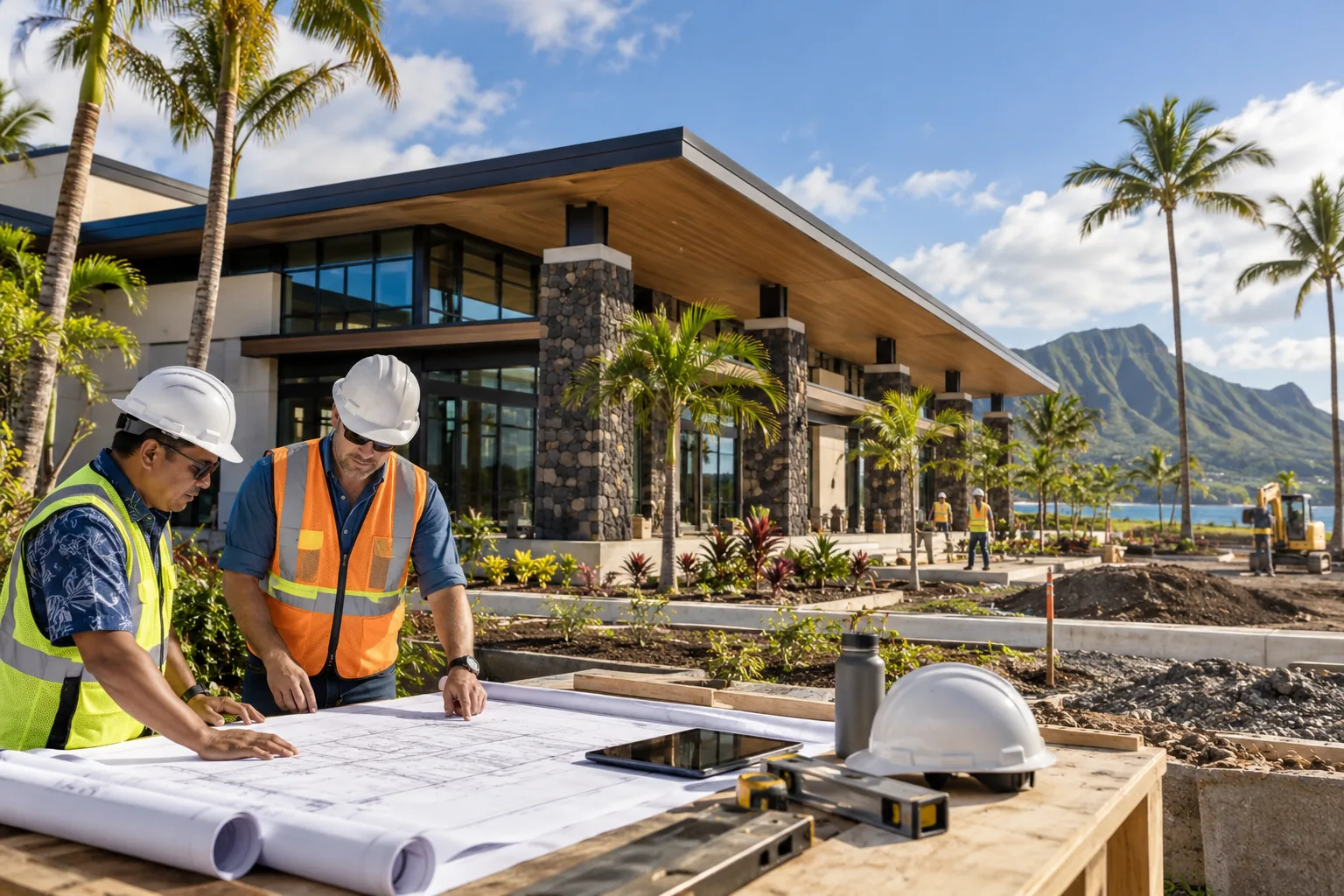
Commercial Estimating Landscape in Hawaii
From major hospitality and resort redevelopments in Waikiki and Kaanapali to commercial retail and distribution warehouses in Kapolei and Hilo, our takeoffs account for Hawaii’s distinctive material, corrosion, and logistical realities.
Hawaii State Building Code Council (SBCC) & County Building Departments
Governing Framework: Statewide Framework with Mandatory County Adoption
Governs commercial plan review baseline requirements, occupancy classifications, and state-level regulatory jurisdiction.
Hawaii State Building Code Council adopts 2018 IBC with Hawaii State Amendments; enforced by the 4 county building departments
Baseline standard for structural load paths, fire-resistance assemblies, egress geometry, and life-safety systems.
2018 International Energy Conservation Code with Hawaii State Amendments
Governs building envelope continuous insulation, fenestration U-factors/SHGC, lighting power density (LPD), and HVAC efficiency ratings.
Building Code Adoption & Permitting Framework
Accurate commercial estimating requires understanding how statewide building standards interact with local municipal Authority Having Jurisdiction (AHJ) amendments.
Jurisdiction & Regulatory Structure
100% ocean freight material logistics from mainland ports, volcanic basalt (blue rock) excavation, extreme marine salt-spray corrosion (hot-dip galvanizing and 316 stainless steel), and 130-150 mph hurricane wind design.
Commercial Energy Code & Envelope Baseline
Commercial projects must comply with 2018 International Energy Conservation Code with Hawaii State Amendments. Estimators must carefully verify continuous insulation (ci), fenestration thermal performance, and mechanical economizer thresholds before finalizing quantity takeoffs.
Verified Primary Regulatory Sources
The following official state regulatory resources govern construction standards and energy compliance for projects in Hawaii:
- Hawaii State Building Code Council (SBCC) — Adopted Codes ↗ — Hawaii Department of Accounting and General Services
- City and County of Honolulu Department of Planning and Permitting — Building Codes ↗ — City and County of Honolulu DPP
- US DOE — Hawaii Commercial Energy Code Status ↗ — US Department of Energy
Official sources independently verified for jurisdictional reference. Statutory adoption varies by municipality, occupancy classification, and local permit date.
State-Specific Takeoff & Bid Preparation Workflow
Our remote commercial estimating methodology ensures every plan set in Hawaii undergoes systematic drawing reconciliation and audit-ready takeoff generation.
Identify which island county governs the project (Honolulu, Maui, Hawaii, or Kauai). Inspect structural general notes for hurricane wind speed (130-150 mph) and seismic design category (SDC D/E on Big Island). Check geotechnical report for blue rock (basalt) depth.
Isolate civil sitework scopes: quantify volcanic basalt rock excavation requiring heavy hydraulic breakers. Quantify corrosion-resistant structural fasteners: hot-dip galvanized or 316 stainless steel anchors within marine splash zones.
Reconcile tropical building envelope assemblies under Hawaii Energy Code: cool roof reflectance, solar heat gain coefficient limits (SHGC <= 0.25), and natural ventilation exemptions.
Check Division 05 metals for hot-dip galvanizing per ASTM A123 and Division 07 roofing for hurricane uplift attachment listed in county building standards.
Document assumptions regarding ocean freight surcharges, harbor demurrage fees, local general excise tax (GET) pass-through, and specialized crane mobilization from off-island.
Takeoff Scope Model: Commercial Retail & Hospitality (36,000 Gross SF, 2 Stories, Structural Steel Frame with Reinforced CMU Core)
This illustrative takeoff models volcanic rock excavation, corrosion-resistant framing, and hurricane roof assemblies in Oahu.
| Scope Assembly | Measured Quantity / Basis | Takeoff Unit Basis |
|---|---|---|
| Volcanic Basalt Rock Trenching & Mass Excavation | 4,200 | CY (Heavy hydraulic breaker & ripping allowances) |
| Hot-Dip Galvanized Structural Steel Framing | 260 | Tons (Marine-grade coated wide-flange & tubes) |
| Reinforced 8" CMU Exterior Walls (Fully Grouted) | 22,400 | SF (Epoxy-coated rebar, continuous bond beams) |
| Hurricane Uplift 60-mil Single-Ply Roof Assembly | 18,500 | SF (Mechanically fastened over polyiso, SRI >= 82) |
| 316 Stainless Steel Exterior Fasteners & Connectors | 8,500 | Fasteners (Marine corrosion protection) |
Key Takeoff Considerations for this Scope:
- Civil sitework captures volcanic rock excavation based on geotechnical core samples.
- Structural steel takeoff itemizes hot-dip galvanizing and marine epoxy primer.
- Roofing scope itemizes high-reflectance cool roof membrane and enhanced perimeter hurricane fastening.
Critical Trade Coordination Points for Hawaii
Commercial estimating requires rigorous alignment between interconnected CSI divisions. Here are key trade coordination checkpoints relevant to Hawaii projects:
Sitework →
Sitework estimating in Hawaii requires budgeting for dense volcanic rock excavation and coastal coral sands.
Key Takeoff Checkpoints:- Quantify volcanic basalt (blue rock) excavation requiring heavy hydraulic hammer attachments.
- Measure imported engineered fill where native volcanic soil is unsuitable for structural support.
- Itemize coastal erosion control silt curtains and dust control measures per county water quality rules.
Structural Steel →
Steel estimating in Hawaii requires pricing hot-dip galvanizing and marine-grade corrosion coatings.
Key Takeoff Checkpoints:- Quantify hot-dip galvanizing (ASTM A123) across all structural steel shapes exposed to marine air.
- Measure Type 316 stainless steel anchor bolts, clip angles, and through-bolts in exterior assemblies.
- Itemize hurricane uplift tie-down straps, column-to-beam moment connections, and shear wall embeds.
Roofing →
Commercial roofing takeoffs in Hawaii require high solar reflectance and extreme wind resistance.
Key Takeoff Checkpoints:- Quantify white single-ply membrane (TPO/PVC) with initial Solar Reflectance Index (SRI) >= 82.
- Break out perimeter and corner uplift zones with increased fastener density for 140+ mph wind speeds.
- Itemize heavy-gauge stainless steel edge metal and copings tested per ANSI/SPRI ES-1.
Project Documents Needed for an Accurate Hawaii Estimate
To deliver an audit-ready quantity takeoff for your project in Hawaii, we require the following drawing packages and project records:
Submission Requirement
Architectural Plan Set (demising walls, floor plans, building elevations, wall sections)
Submission Requirement
Structural Engineering Documents (wind criteria sheet, framing layouts, tie-down schedules)
Submission Requirement
Mechanical, Electrical, and Plumbing Plans & Schedules
Submission Requirement
Geotechnical Engineering Report (volcanic rock profile, coral sand bearing capacity, groundwater levels)
Submission Requirement
Hawaii Energy Code Compliance Package (tropical envelope calculation forms)
Submission Requirement
Project Specification Book (Divisions 01 through 33)
Frequently Asked Questions: Hawaii Construction Estimating
Direct answers to common questions about commercial quantity takeoffs, local jurisdiction adjustments, and remote estimating deliverables in Hawaii.
What building codes govern commercial construction in Hawaii?
Hawaii commercial construction is governed by the Hawaii State Building Codes adopted by the State Building Code Council (SBCC), based on the 2018 International Building Code with state amendments. Each of the four county building departments (Honolulu, Maui, Hawaii, Kauai) enforces the code with local county amendments.
How do island logistics affect commercial construction estimating in Hawaii?
Hawaii imports the vast majority of its commercial construction materials via ocean freight from the US West Coast. Estimators must account for container shipping rates, harbor handling fees, extended procurement lead times, and on-island storage logistics when preparing material schedules.
Why are corrosion-resistant materials mandatory for commercial work in Hawaii?
Due to constant trade winds carrying airborne sea salt, commercial structures in Hawaii experience severe atmospheric corrosion. Structural steel, fasteners, exterior metal framing, and rooftop mechanical equipment must typically be specified with hot-dip galvanizing, marine epoxy coatings, or Type 316 stainless steel.
Does CommercialEstimatePro operate local offices in Hawaii?
No. CommercialEstimatePro is a nationwide remote construction estimating service. We do not have local offices, physical estimating personnel, or resident contractors in Hawaii. All takeoffs are produced digitally from contractor-provided design documents.
Get an Audit-Ready Commercial Estimate for Your Hawaii Project
We provide remote quantity takeoffs and commercial construction cost estimates to general contractors, subcontractors, architects, and owners across Hawaii and all 50 states. Every takeoff is itemized by CSI MasterFormat division with complete visual audit markups and customizable Excel workbooks.
CommercialEstimatePro operates as a centralized remote commercial estimating consultancy. We do not maintain local field offices or resident staff in Hawaii, nor do we provide licensed architectural, structural engineering, or on-site building inspection services. All material quantities and equipment counts are measured directly from your furnished design documents.
Explore Core Services, Trades & Sectors
Navigate our complete suite of commercial takeoff services, CSI division guides, and project types: