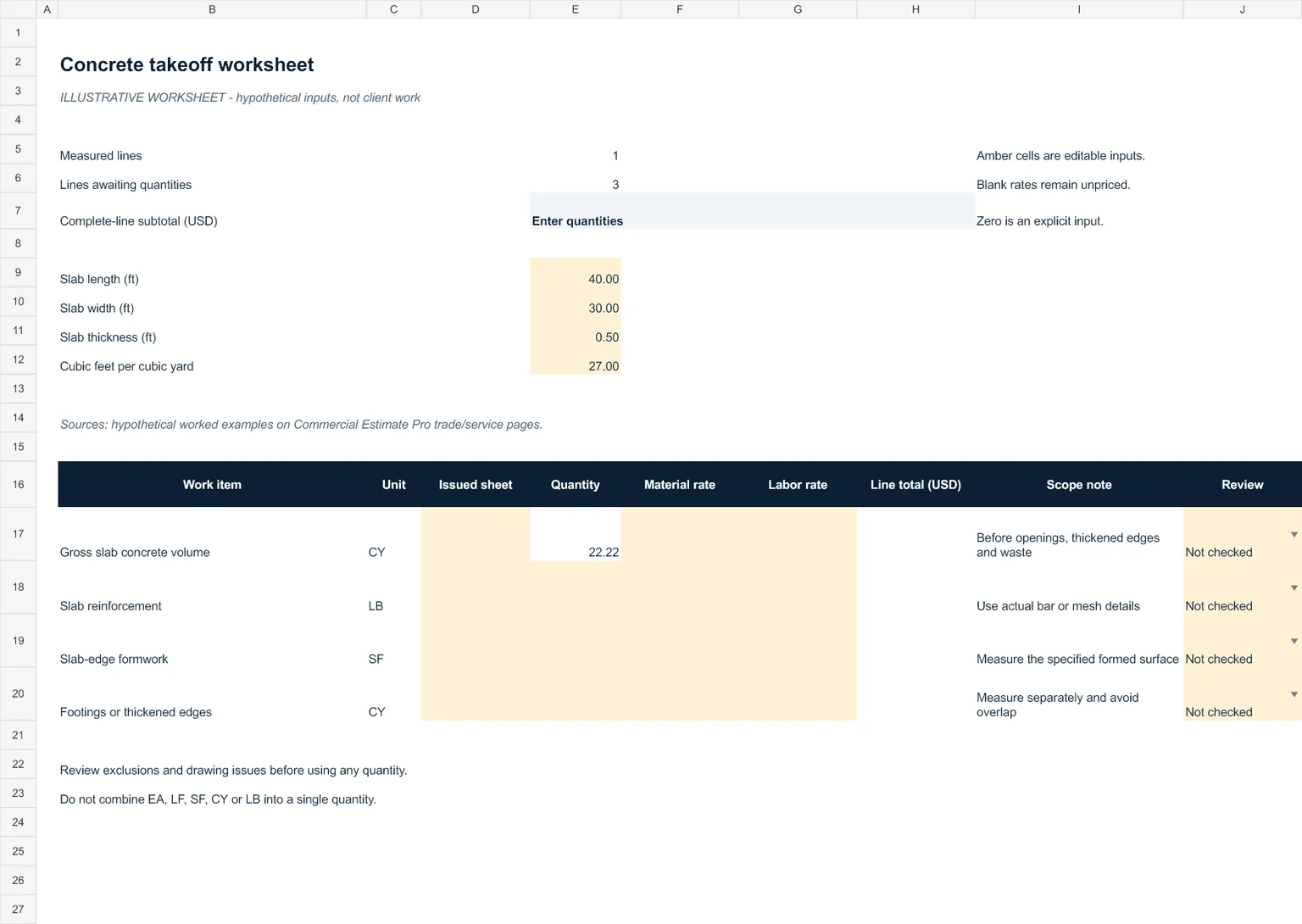
Worked quantity example
A 40 ft × 30 ft slab at 0.5 ft thickness has a gross volume of 600 cubic feet. Dividing by 27 gives approximately 22.22 CY.
Use one consistent length unit
Convert slab thickness to feet before multiplying. Six inches is 0.5 feet. The 40-foot length, 30-foot width and 0.5-foot thickness give 600 cubic feet of gross geometric volume.
A yard has three feet, so a cubic yard has 3 × 3 × 3 = 27 cubic feet. Divide 600 by 27 to obtain approximately 22.22 CY. Retain the unrounded calculation until the purchasing or estimate rounding rule is defined.
Reconcile geometry with the structural details
Openings, depressions, footings and thickened edges need separate dimensions. If a footing overlaps the slab geometry, establish the measurement boundary so the same volume is not counted twice.
Reinforcement, formwork, finishes, excavation and waste are separate scope decisions. The worksheet uses distinct units for these lines and leaves unknown quantities blank. Gross volume should not be presented as a confirmed concrete order.
Drawing inputs to confirm
- Structural plans, sections and slab-edge details
- Reinforcement schedules and concrete specifications
- Opening dimensions, foundation drawings and addenda
Checks before applying a rate
- Convert every dimension to a consistent length unit
- Keep gross volume and deductions traceable
- Separate slab, footing, wall and thickened-edge geometry
- Document reinforcement, finish and formwork boundaries
What the worksheet can and cannot establish
Gross geometric volume is not an order quantity. Openings, waste, over-excavation, thickened edges and field conditions require project-specific review.
Enter project-specific quantities, sheet references and rates in the amber input cells. Quantity formulas remain live. The line cost requires numeric quantity, material rate and labor rate; the subtotal identifies missing inputs instead of presenting an incomplete scope as a completed price.
Review comments and document references are editable. Confirmation in the drawing register records your own review and does not imply company signoff. The published example has no supplied client drawing set or named expert review.